Save on your AI bill, don't compromise on quality.
Claude, ChatGPT, Gemini and open models for every employee, with budget caps and audit logs. No seat minimum, no annual commitment.

Token spend commitment
Seat minimums
Models available
Platform fee
Desktop app
Spend visibility
Enterprise terms as published by Anthropic and OpenAI. Seat minimums and commitments vary by contract.
How Harriet compares to Claude Enterprise
Spend you can see.
Cost by team, model and task, visible as it happens rather than on the invoice.
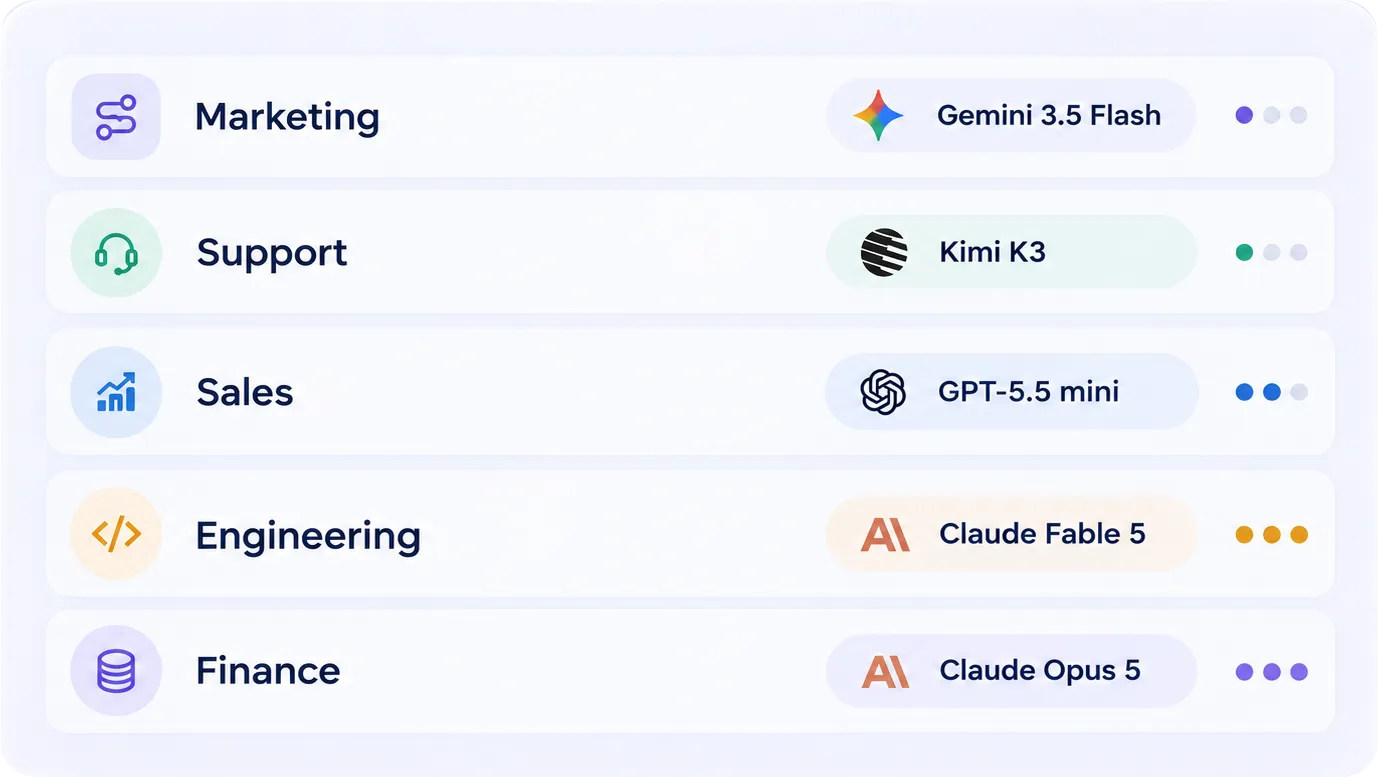
Intelligent model routing.
“We saw a significant decrease in our AI bill because people were using Opus to write Slack messages.”
Questions finance asks first.
How does Harriet actually save money?
Most teams pay frontier prices for tasks fast models handle perfectly well. Harriet sets a policy: keep frontier for the few people who need it, and default everyone else to capable-enough models that cost a fraction as much.
Will my team notice a downgrade?
Not for the work fast models are made for. For everything else, they get a one-tap "switch model" prompt, and Harriet routes within the policy you set, so no one is locked out of frontier when they truly need it.
Do we keep our existing AI vendor contracts?
Two ways, your call. Bring your own keys for OpenAI, Anthropic, and Google, so you keep your provider relationships, committed-spend deals, and rate limits, and pay no LLM charge to us. Or use Harriet Managed Credits for a single invoice with access to all the frontier labs as well as high-quality open-weight models. You can mix the two per user and switch at any time.
How long does it take to roll out?
Under an hour for the whole company. Connect your identity provider, import teams automatically, set a default policy, and push to every device via MDM or a single command.
How do we reduce AI costs across the organisation?
Three levers, in order of impact. Route everyday work to capable fast models and keep frontier models for the people and tasks that need them. Cap spend per team and per user so nobody discovers the bill after the fact. And stop paying seat fees for people who barely use the tool, which is what a seat minimum forces you to do. Harriet does all three from one policy screen, across Claude, ChatGPT, Gemini and open models.
What is AI spend management?
Seeing what AI costs by team, model and task as it happens, and being able to act on it: set a budget, route a task to a cheaper model, or switch a heavy user to a different default. Vendor consoles show one total per vendor. Harriet shows the whole picture across vendors and lets you set hard caps, not just alerts.
What does Claude Enterprise cost compared to this?
Anthropic publishes $20 per seat a month, billed annually, plus usage at API rates, with a 20-seat minimum. The full breakdown is on our Claude Enterprise pricing page, and the Claude Team vs Enterprise page covers the moment teams outgrow the flat-price plan.
Ready to cut your bill?
Book a 20-minute call and we'll size the saving with you on a screen-share.